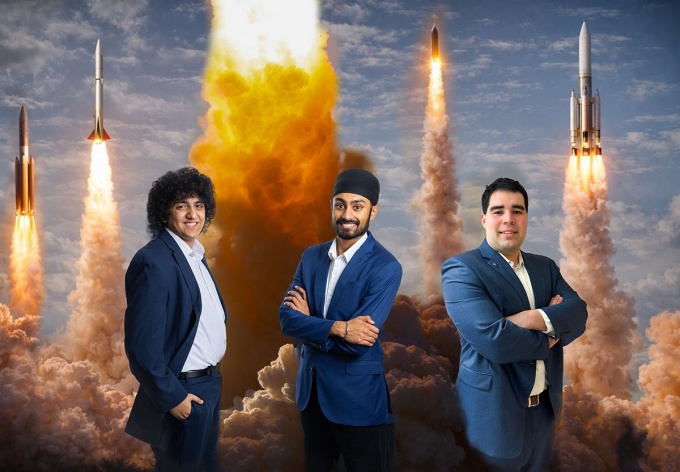
Winners of this year’s Panasci competition, LAZZCO Rocketry cofounders have been collaborating on engineering projects since middle school. Now they see a lane to a big business opportunity.
Sitting in the audience of last year’s Panasci competition, Arjun Kodial turned to his longtime friend Zyad Zahra and said, “That could be us on the stage next year.”
And so it was.
UB computer engineering students Kodial and Zahra, along with their longtime friend Ziad ElNasser, took home first prize Thursday in the region’s premiere collegiate entrepreneurship program. Their company, LAZZCO Rocketry, will develop and manufacture high-quality model rockets.
They wooed the judges first by the presence of an enormous rocket – a real one, not a prop – and followed through with their plans to solve the supply problem in the model rocketry world.
Working out of the Upstate Rocketry Research Group in Youngstown, they plan to have full model rocket engines on the market by year’s end.
“We’ll be selling into a starving market of hobbyists and educational institutions,” said elNasser, a chemistry major at Cornell University. “They’ll be able to buy our models and continue their passion for rocketry.”
The annual competition – officially called the Henry A. Panasci Jr. Technology Entrepreneurship Competition – was created by the University at Buffalo’s School of Management in 2001. The winning team earns $25,000 in seed money along with in-kind services valued at $40,000. RecycleVision AI was the second-place winner, taking home $10,000 in startup funding.
Kodial, Zahra and ElNasser have been friends since middle school. They started a model rocketry club at Williamsville East High School, which led them to Upstate Rocketry and their mentor, Larry Weibert
This experience allowed them to follow their passion for model rocketry, but also exposed them to a persistent problem: the lack of supply for high-quality model rocket engines. Clubs across the U.S. often have to postpone events or plan around their ability to procure them.
LAZZCO was created to be a long-term answer to that question. The Panasci support will allow the team to embark on the necessary certifications and testing that will allow them to sell model rocket engines commercially. The founders all plan to graduate within the next 18 months, and to pursue the business fulltime.
“I’ve known these guys since middle school, and we’ve always done engineering projects together, and there’s no other team I’d rather have,” Kodial said. “We were going to do this either way, but Panasci is our launch pad into the commercial market.”