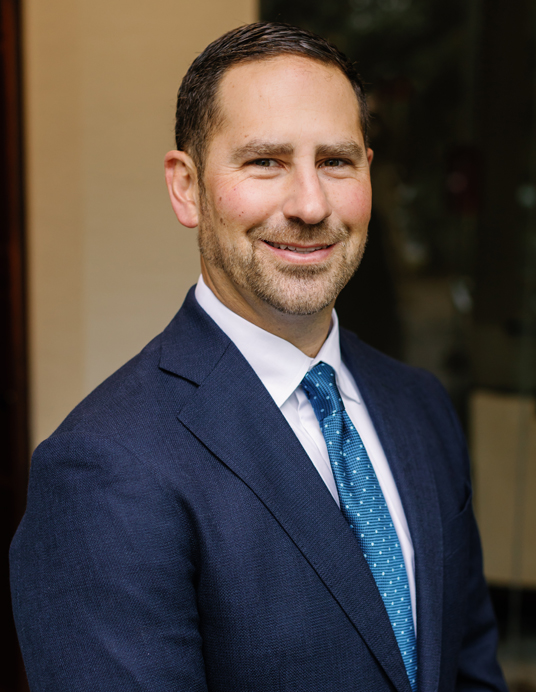
As Senior Director at Paramax, Feine works with business owners approaching some of the biggest financial decisions of their lives.
For much of the past 20 years, Josh Feine has had a front-row seat to some of the most consequential business and financial moments in Buffalo.
He was inside the Buffalo Bills as the franchise transitioned from the Wilson family to the Pegulas and Pegula Sports and Entertainment took shape.
He later became one of the youngest executives at New Era Cap, helping transform its sport marketing business and eventually sitting on the senior leadership team as the company went through its own private-equity transaction.
Along the way, he launched an investment fund with a group that included Josh Allen, moved into venture capital and accumulated an unusually wide-angle view of business: banker, corporate executive, dealmaker and investor.”
Now he’s on the other side of the table.
As Senior Director at Paramax, Feine works with business owners approaching some of the biggest financial decisions of their lives. Paramax has completed more than 500 transactions over its 30-year history and is now expanding beyond its Western New York roots.
It comes at an interesting moment for Buffalo. A generation of business owners is approaching retirement, putting thousands of companies, jobs, and enormous amounts of locally created wealth into transition.
For Feine, a 43North Foundation Ambassador, all those seemingly disparate stops in his career increasingly look connected: two decades spent watching what happens when businesses, ownership, and wealth change hands.
Check out other 43North Foundation Ambassador profiles: Marc Izzo and Gene Gramza; Cory Van Deusen and Paul Herlan; Frank and Cynthia Ciminelli.
Let’s start with the Bills. How did you end up there?
I was a commercial lender for HSBC and was working with a customer base of fantastic Western New York family-owned businesses when I met Bruce Popko (now president of New Era Cap), who had just joined the Bills under Russ Brandon to run all Business Development.
Bruce came in from Cleveland and had deep roots in pro sports. As we got to know each other, he said, “Listen, I need somebody who can help me navigate the Western New York business community. I think you could do really well in what we do, but you need to come over and learn the business.”
I remember saying, “What the hell do you even do? What do you sell”
The answer was sponsorships, corporate partnerships, naming rights, suites, etc. I thought, ok, this is worth a try.
So I joined the Bills as Director of Business Development. I was basically the only person at that level who had never sold sponsorships before. I had jumped the line a little bit, and there were some who said, Who the hell is this guy? I had never sold anything in pro sports, and I was coming in at a pretty high level. It was go time!
But I did incredibly well under Bruce’s guidance, and we had an awesome team, including people I’m very close with today who are still at the organization. Bruce is an incredible leader and someone who taught me a lot about business.
And you arrived at a pretty remarkable moment in the history of the franchise.
It was a fascinating time because the organization itself was changing. Russ was bringing in new people and new ideas, and then we went through the transition from the Wilson family to the Pegulas.
That was my first real experience with a major transition and sale.
Pegula Sports and Entertainment was being created. I remember sitting on the 26th floor of HSBC Tower at folding tables, basically saying, “All right, what are we doing now? We’re selling the Sabres. We’re selling Black River Entertainment. We’re selling the Bandits. We’re selling the Bills.”
It was exciting.
How did that lead to New Era?
Around that time, I had sold the naming rights to the Bills practice facility to ADPRO, and we were searching for a naming-rights partner for the stadium. New Era was a client of mine and one of the companies we were working with, and I had gotten close with Chris Koch.
One snowy February night, Chris and I were sitting at Frankie Primo’s. I told him I felt like I was hitting a plateau at the Bills. I had this entrepreneurial spirit and wanted to buy a company or do something different. I grew up in a family steel business and my wife was working for her father, Russ, at Paramax. I had this itch I needed to scratch and loved speaking with successful business owners and founders for advice and to hear their stories.
I was really asking Chris for advice, as he had taken New Era to new heights and I admired what he had built. He was an entrepreneur who had taken over a family business and grown it tremendously.
Instead, he said, “Why don’t you come over and run our sports marketing division?” I was flattered and incredibly touched that he offered this up, but again didn’t really know what this meant.
After a number of long conversations and discussions with Paul McAdam (then New Era President of North America and now President of BruMate) to better understand the role, I went back to Bruce and told him I didn’t know what to do. I was incredibly loyal to him, he was my guy, but this other opportunity had opened up, and it seemed like an incredible opportunity.
Bruce told me to go do it and, like any great leader, supported the move.
So I did.
What did you walk into at New Era?
I was the youngest executive on the team at the time. It was another period of major transition, with a whole new group of people coming into the company.
I became responsible for our in-venue partnership deals and in-venue revenue across North America. I was tasked with thinking about how to transform a relatively mature business and take it to the next level. This time, I was sitting on the other side of the table and negotiating with ex-colleagues and I was now the buyer of everything I used to sell!
It was an amazing experience. We built an incredible team and dramatically changed the scale and economics of that part of the company.
I also eventually went through the private-equity transaction as part of the senior leadership team. So again, I got to see a major transaction from the inside.
And New Era is also where you began exploring venture investing?
I was signing New Era’s athletes and ambassadors during my tenure. And I started noticing something changing in what athletes and their agents wanted.
Cash wasn’t necessarily the most compelling thing anymore. A couple hundred thousand dollars might buy jet fuel or a new car, but it wasn’t going to change an elite athlete’s life. We were fortunate, our roster of athletes and ambassadors were the top names in their respective sports.
They had watched what happened with Michael Jordan, Kobe Bryant, or Dr. Dre. They saw athletes and artists investing in brands, receiving equity and helping those brands grow. They were thinking about wealth creation differently.
I started thinking: Why can’t I create something around this? Why can’t I build an avenue for athletes to participate in venture capital and startups?
That became Forma Capital, which is still active and we are currently investing in new opportunities.
And Josh Allen was your first call?
My first call was Josh Allen.
Josh and I become really close through our New Era days. I told him what we were thinking about doing, talked with his wealth advisor and agent, and Josh essentially said, “I’ll support you.” He wrote us our first check.
We made him a partner. From there came Jayson Tatum and other athletes and celebrities, and we started investing, particularly around consumer brands and sports opportunities.
It is a small fund, and frankly, we picked a brutal time to become first-time fund operators. Fundraising was incredibly difficult, and consumer investing was out of favor.
But we have had some successes and continue to find fantastic opportunities to invest in, and we have learned a tremendous amount and kept building from there.
So after banking, the Bills, New Era and venture capital, why Paramax?
My father-in-law, Russ D'Alba, who founded Paramax, approached me almost three years ago. Russ is the epitome of an entrepreneur. He has founded two incredibly successful businesses and has been someone I have admired greatly since I first met my now wife, Andrea. He told me I had this unusual combination of experience: commercial banking, operating experience, business development, sports, venture capital.
My initial answer was no. Not because I didn’t think it was a fantastic opportunity, but because I was worried about the family aspect.
My wife, Andrea, already worked there and had for more than 15 years. It was her family business. I thought, This is not going to work and the last thing I want to do is mess up or disrupt what is a very good family dynamic.
But after thinking long and hard about it, I realized it might actually be exactly what I was looking for.
It gave me an entrepreneurial opportunity. It gave me the ability to go out and drive a business forward. And there was a legacy component that mattered to me.
Russ took all the risk. He built this company from scratch 30 years ago. He had the guts to go out and risk everything. He was a first generation child, grew up on Jersey Street on the west side of Buffalo and he created all this. I am just fortunate to be here and to be given the opportunity to carry his legacy forward. It’s pretty special and I get to do it alongside my wife and this incredible team.
The question became: What can I do to help take that legacy to the next level?
Is this where all those different experiences finally come together?
I think so.
I’ve sat on the commercial banking side and looked at businesses through the lens of a lender. I’ve operated inside a major consumer brand. I’ve worked in professional sports. I’ve been involved in venture investing. I’ve invested in private equity. I’ve experienced major corporate transactions from inside the senior leadership team.
And now I sit on the investment banking side and think about marketability: How do we transact this business? How do we position it? How do we maximize value?
It makes me a little bit of a Swiss Army knife.
When I’m sitting across from an entrepreneur or business owner, I’m not looking at their situation through one narrow lens. I’ve been fortunate enough to see businesses from a lot of different angles.
What do you like about being on this side of a transaction?
You get this incredible look inside people’s businesses. Two companies might look exactly the same from the outside, and then you get inside and discover that they operate completely differently.
But the most meaningful part is watching these life-changing moments happen when businesses transact.
You’re seeing 30 years, 50 years, sometimes 100 years of blood, sweat and tears come to a culmination.
That is incredibly significant for the owner and their family, but the impact can go much further than that.
I think about one past client of ours. Paramax worked on that transaction nearly two decades ago. Today, there is a significant foundation in our community that exists because of the proceeds from that transaction, and it is making an enormous impact in this community.
That waterfall effect is something people don’t always think about, but the impact can affect so many lives into the future.
That feels especially relevant right now. Buffalo has a huge generation of business owners approaching retirement. What happens to all of those companies?
That’s a real concern.
A high percentage of businesses actually won’t transact. They won’t transition. They’ll just close.
If those are small businesses that employ 10, 20 or 30 people, that’s 30 people who are out of jobs and don’t know where to go next. That’s the backbone of our community.
We want to be that resource, so people don’t feel like they don’t have options or someone to turn to for advice.
Sometimes that means selling the company. Sometimes it means transitioning it internally. Sometimes private equity can provide a structure where the son or daughter still has ownership, but dad or mom gets that liquidity event and can de-risk a lot of that concern.
There are tons of options out there, which is great.
Getting that story out there is critical, so people understand there are options and you don’t have to sit there and struggle through it.
And what’s the opportunity for Paramax in all of that?
We have an incredible story of 30 years and more than 500 transactions closed since inception.
It’s important that we keep our finger on the pulse on this marketplace and are the go-to resource for anybody who’s looking to transact or needs advice on what to do with their business.
We, too, are a founder-led business. We get it and understand what owners are thinking and needing.
We have to look at other markets, scale our business and expand our footprint to continue growing.
We already have Rochester, and we recently expanded into Pittsburgh. Pittsburgh is really a larger Buffalo, with similar industries and culture, and very similar people. We think it’s going to be a great opportunity.
We’re not trying to become the biggest boutique investment bank. We know where we play and we know who we are.
But we have a great opportunity to continue building upon the success that Russ created.
Twenty years from now, what do you want to have built?
My goal and my aspiration is to grow Paramax alongside our current and future team members. I don’t have a number where I say it has to double, it has to triple, it has to whatever. My goal is to build Paramax for perpetuity — an enduring institution that serves as a trusted resource to founders, entrepreneurs, business owners, and their families.
Paramax will continue to differentiate itself by combining white-glove service with first-class investment banking capabilities and an unwavering commitment to exceptional outcomes. Every engagement will be approached with the understanding that, for our clients, these transactions are about far more than valuation. They represent decades of work, family legacies, employees, communities, and the next chapter of their lives.
I envision Paramax offices strategically placed throughout the country, all performing at an incredibly high level, without losing who we are andwhat got us to this point. Really at the end of it… I am just hoping to build upon what Russ built and be one piece of the team that helps take it to the next level. We have an incredible team and I cannot wait to see what the future holds in store of all of us.
At the same time, I feel like I have a lot to give to this community. A community that has given me and our family so much.
There are a lot of entrepreneurs doing amazing things and flying by the seat of their pants. I think I come from an interesting vantage point where I can provide sound advice on so many aspects of their business, but also ask: What are you trying to accomplish? Where are we going with this? What does success look like?
And then there’s that next generation of leadership in this community.
To your earlier point, people are starting to pass the torch. Who are they passing it to?
I want to be part of that next generation. It’s important for me. I want my kids to come back here when they are older and raise their families.
I’m incredibly passionate about keeping that train on the tracks. You go to other cities and see what’s going on and what they’re building.
And you think, Why not us?