The Williamsville native built a career at the intersection of Wall Street and Silicon Valley. Through it all, Buffalo has remained close to her heart.
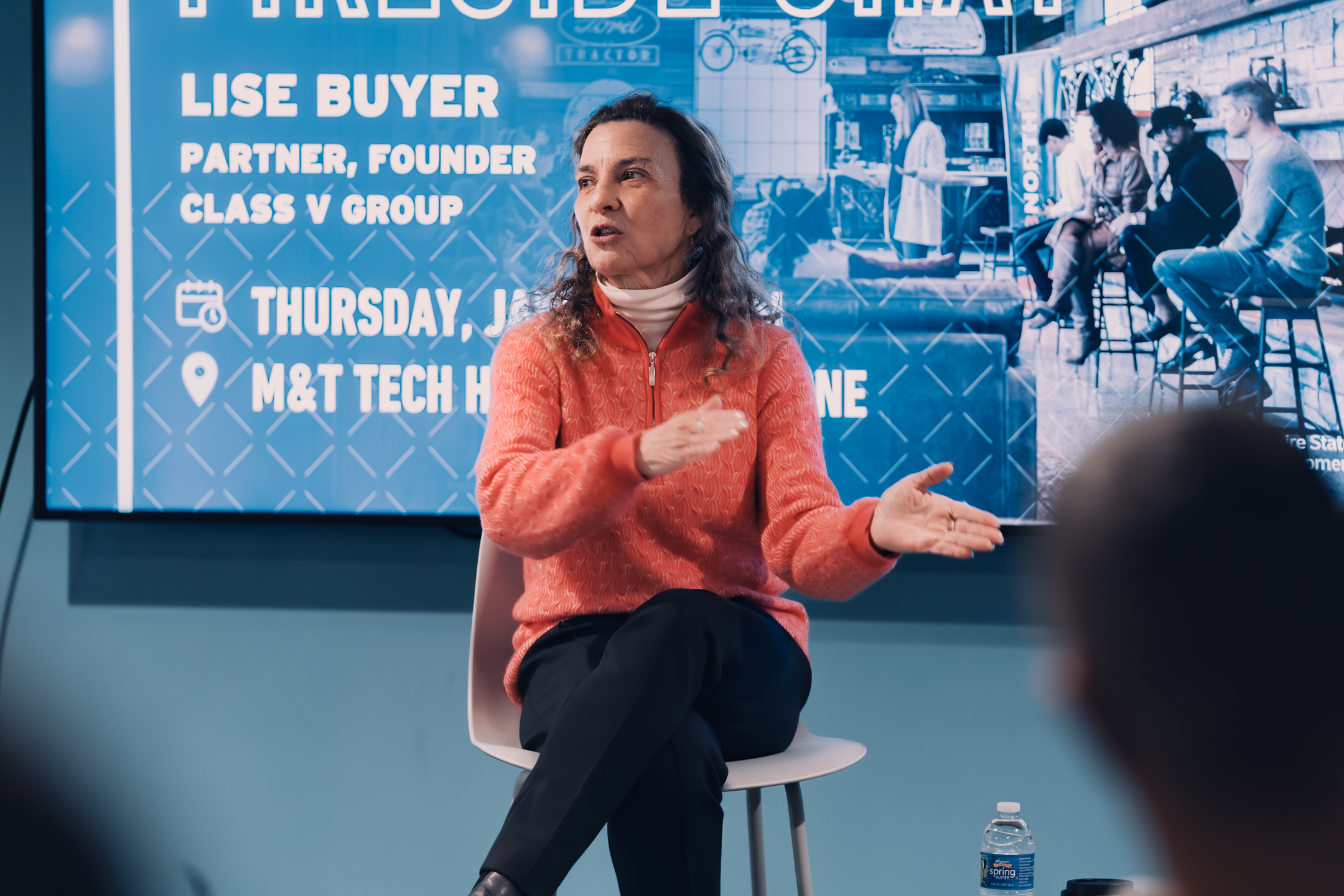
Lise Buyer has spent much of her professional life at the intersection of technology, finance and entrepreneurship.
The Williamsville native began her career on Wall Street, analyzing retail and technology stocks before moving into investment management at T. Rowe Price and investment banking at Credit Suisse First Boston. She was on the front lines of the internet boom, watching an emerging industry transform the global economy.
Then came Google.
Buyer joined the search engine company about a year before its landmark 2004 initial public offering, helping its founders navigate a process they were determined to approach differently. The experience fundamentally changed how she thought about entrepreneurship and the public markets.
In 2007, she founded Class V Group, an advisory firm that works with management teams preparing to take their companies public.
Along the way, Buyer has maintained strong ties to Western New York, returning frequently, supporting local cultural institutions and following Buffalo's emerging entrepreneurial community. Buyer was recently a judge at the 43North Finals event in October.
Series B caught up with Buyer to discuss her journey from Williamsville to Silicon Valley, the lessons she learned from some of technology's most influential founders and why she remains optimistic about Buffalo's future.
You grew up in Williamsville during a period when Buffalo was facing some significant economic challenges. How did that experience shape you?
I can't think of a nicer place to grow up. I loved the seasons, I loved skiing, and I even worked at Kissing Bridge. Of course, there were mornings when you had to get up and shovel snow before you could catch the school bus.
I think Buffalo teaches you grit. You learn that you can achieve some degree of success, but you're not entitled to anything. You have to earn it. A booster shot of luck helps as well!
Growing up here in the 1970s, when so many things seemed to be going in the wrong direction economically, you also learned to look for the good when all the headlines were bad.
I think that perspective has stayed with me throughout my career. You're going to encounter obstacles. You're going to have doors slammed in your face. You just keep going.
And when I look at Buffalo today, I see considerably more optimism than there was a decade ago. There are still real challenges, of course, but there's a sense that things are moving in the right direction.
You went from Williamsville to Wall Street and eventually became deeply involved in the technology industry. How did that happen?
I knew I wanted to go to Wall Street. It wasn't that I felt I had to leave Buffalo. There was only one Wall Street, and that's where I wanted to be.
Getting there wasn't easy. I wrote a lot of letters, made a lot of phone calls and had doors slammed in my face with great frequency. I didn't have Wall Street experience, and being a woman at the time didn't make it any easier.
Eventually, I got an opportunity and started analyzing companies in industries ranging from chemicals and metals to retail.
What really changed things for me was the emergence of personal computers. Technology analysts understood computers, but they didn't necessarily understand retail distribution. Retail analysts understood stores, but they didn't know much about the computers being sold in them.
I realized there was an open lane, and I decided to go through it.
I could visit a computer store on Sheridan Drive, count the boxes of HP printers and potentially learn something about the business that other analysts didn't know.
One Christmas, I rented a car and drove around Buffalo interviewing 27 department store Santas about which toys children were asking for. The answer was Teenage Mutant Ninja Turtles.
That kind of extra legwork could give you an edge.
And as I became more involved in technology, I fell in love with the industry. Most of these companies were going to fail, but some were going to change the world. I was fascinated by entrepreneurs who believed so strongly in what they were building that they simply wouldn't take no for an answer.
You eventually joined Google before its IPO. What did that experience teach you about entrepreneurs?
It was an extraordinary learning experience.
I'd been on the buy side as an investor and the sell side on Wall Street. I'd also spent some time in venture capital. But I'd never actually worked inside a company going through the process.
From the outside, it's easy to tell a management team, "You're at point A, and you need to get to point B." Once you're inside, you discover that getting from A to B requires stops in Minneapolis and Topeka, and there are all sorts of complications you never anticipated.
I joined Google about a year before its IPO, and one of the most important things I learned came from the founders.
They had very strong opinions about how they wanted to approach the IPO. I came from Wall Street, where there were established ways of doing things. I'd say, "You can't do that. That's not how it's done."
And they would ask, "Why?"
I'd explain, and they'd ask again, "Why?"
Eventually, it dawned on me that their questions were the right ones and that my conventional thinking was wrong. We started taking the entire process apart and asking which things were actually required by regulations and which were simply conventions.
It was sometimes painful, but it was an amazing education. They were right to keep asking those questions.
I came away understanding that management teams have much more flexibility than they sometimes realize. Just because something has always been done a certain way doesn't mean that's the only way to do it.
That experience eventually led you to create Class V Group. What did you see missing in the IPO process?
I realized that management teams are often extraordinarily knowledgeable about their businesses. They understand semiconductors or software or data centers, but they don't necessarily understand the nuances of going public.
They have plenty of smart advisors, including investment bankers, but those advisors don't always have exactly the same incentives as the company.
I thought there was an opportunity to create a firm that worked solely on behalf of management teams, helping them understand their choices and structure the IPO process around what they actually wanted to accomplish.
That's how Class V Group came about.
And the name has a Buffalo connection.
I wanted something that reflected where I came from. Buffalo Group was taken, and Bison Group wasn't going to work. Then I started thinking about Niagara Falls and the Class V rapids.
If you're going through rapids like that for the first time, you want an experienced guide in the boat with you. That's exactly how I think about the IPO process.
Every company is different. It's not always about raising the most money possible on a particular day. It's about understanding why you want to be public and designing the process to support those objectives.
I started the firm in 2007, which turned out to be rather spectacular timing, in a terrible way, given what happened to the financial markets shortly afterward. But we've navigated the ups and downs, and it's been incredibly rewarding.
You still spend a significant amount of time in Buffalo. What keeps you connected, and what excites you about the region's future?
I have family and friends in the area, I genuinely love Western New York and I spend as much time here as I can get away with. Where else would you rather be?
I've tried to support some of the institutions that make Buffalo special. I served on the Nichols board for a time, and I've supported organizations like the Buffalo Philharmonic and the art gallery.
Years ago, I was fortunate enough to own a stock that did very well, and I essentially traded it for a couple of dinosaurs that now live at the Buffalo Museum of Science.
They're named Seymour and Stanley.
I was a geology major, and as a child I had the opportunity to visit the American Museum of Natural History in New York. I remember how exciting it was to see dinosaurs. I wanted children in Buffalo to have that same experience. Maybe one of those dinosaurs will spark a child's interest in science.
As for Buffalo's future, I love what organizations like 43North are trying to accomplish.
Buffalo has a lot going for it. It's relatively affordable, it has a tremendous manufacturing heritage and there are resources here that have been underutilized for decades. I also think climate change may create opportunities for the region over the longer term.
You look at what's happened along the waterfront over the past 20 years, or the effort to clean up the Buffalo River, and you can see what's possible. It's a big, difficult uphill climb, but progress happens one step at a time.
And there's something about the civic pride here that I don't think you find everywhere.
I can walk around California wearing a Bills hat and have complete strangers shout, "Go Bills!" There's an immediate connection.
I believe the City of Good Neighbors thing is real. And when I look at the energy in Buffalo's entrepreneurial community, I see plenty of reasons to be hopeful.
I like to tell people that the best investment they might make is real estate in Buffalo, New York.