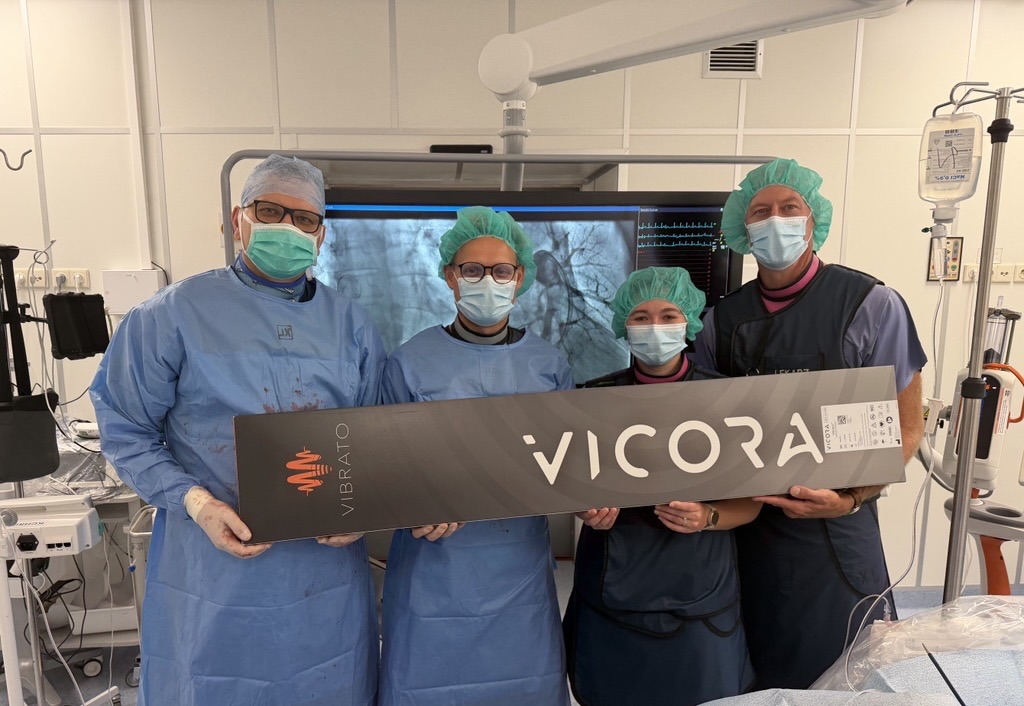
The Buffalo startup has begun its first-in-human study of the Vibrato catheter, a major milestone for the region’s emerging medical device industry.
Shawn Patterson and Erin Garcia were having lunch in Krakow, Poland, when the message they’d been waiting years for finally arrived.
A 74-year-old man had arrived at a nearby hospital with a pulmonary embolism, a potentially fatal blood clot in his lungs. Doctors were ready to use the Vibrato, a new medical device which had never before been used in a live setting.
They jumped in an Uber and raced to the hospital — Garcia had to turn off her watch as it kept sending warning signs about her heart rate. Within an hour, they were watching physicians use their device to remove clots from the man’s lungs.
It saved his life.
“We’ve been working toward this for four years,” Garcia said. “To see the patient there, and then see the results, it was an incredible feeling.”
The Vibrato is being developed by Vicora, a startup that emerged from the Jacobs Institute and is backed by Egret Healthcare Ventures. The company is based in the Red Shed building on Buffalo’s East Side, part of an emerging medical device corridor that includes the Rookery and Ampullae.
Its progress is a compelling example of what's possible when Buffalo's medical research, engineering, investment and commercialization resources work together.
“This is one of the coolest things I’ve done in my career,” said Patterson, Vicora’s CEO. "It shows you can take a medical device idea in Buffalo all the way through development and into patients. Once you do that, it opens the door for a lot more."
From idea to operating room
Egret Healthcare Ventures was formed in 2021 to complement the well-established resources and people already dedicated to building a medical device ecosystem in Buffalo, subsequently spinning out Vicora as its first portfolio company in 2022.
The Vicora team worked collaboratively with the Jacobs Institute’s Idea to Reality (i2R) program, which pairs entrepreneurs with physicians and engineers to turn early-stage medical technologies into viable products. The Jacobs Institute provided physician feedback, prototyping, and preclinical testing.
The University at Buffalo supported through its Center for Advanced Technology program, the Sound and Vibrations Lab, and preclinical testing. And The Rookery helped develop a critical component of the device.
Garcia, a Buffalo native who had moved to Colorado Springs for her career, returned home and joined Egret, which brought her to Vicora in 2023. Patterson, a veteran medical device entrepreneur who founded Resolution Medical in Minnesota and brought technologies to market there, became CEO in 2024.
The team narrowed its focus to larger catheters used to treat pulmonary embolisms and clots in the legs. The resulting device uses vibration to help remove clots and, crucially, is designed to fit into physicians’ existing procedures.
Vicora announced a $3.6 million funding round in May 2025 and recently closed another $2.25 million, bringing its total to nearly $6 million, plus about $1 million in grants. That funding carried the company through product development, testing and its first-in-human clinical study.
Vicora treated its first patient in Kraków, Poland in August and has since treated more as part of a study expected to include up to 10 people. The early results have been encouraging, though larger trials will be needed to establish the device’s performance.
The company has also submitted to the U.S. Food and Drug Administration for 510(k) clearance to treat clots in the peripheral venous system (i.e. upper legs) and expects approval in early 2027. Its bigger target is pulmonary embolism, which would require a U.S. Pivotal IDE study of about 130 patients that could begin in late 2027.
Building a company and an industry
Vicora has retained an investment bank to explore its options, and Patterson said interest has been significant. The company could raise more capital to fund U.S. trials on its own, or it could partner with or be acquired by a larger medical device company. A deal could come as early as 2027.
That’s the model Egret Healthcare Ventures is betting on. The Buffalo-based venture builder provides funding, operational support and expertise to early-stage medical device companies, including Ampullae.