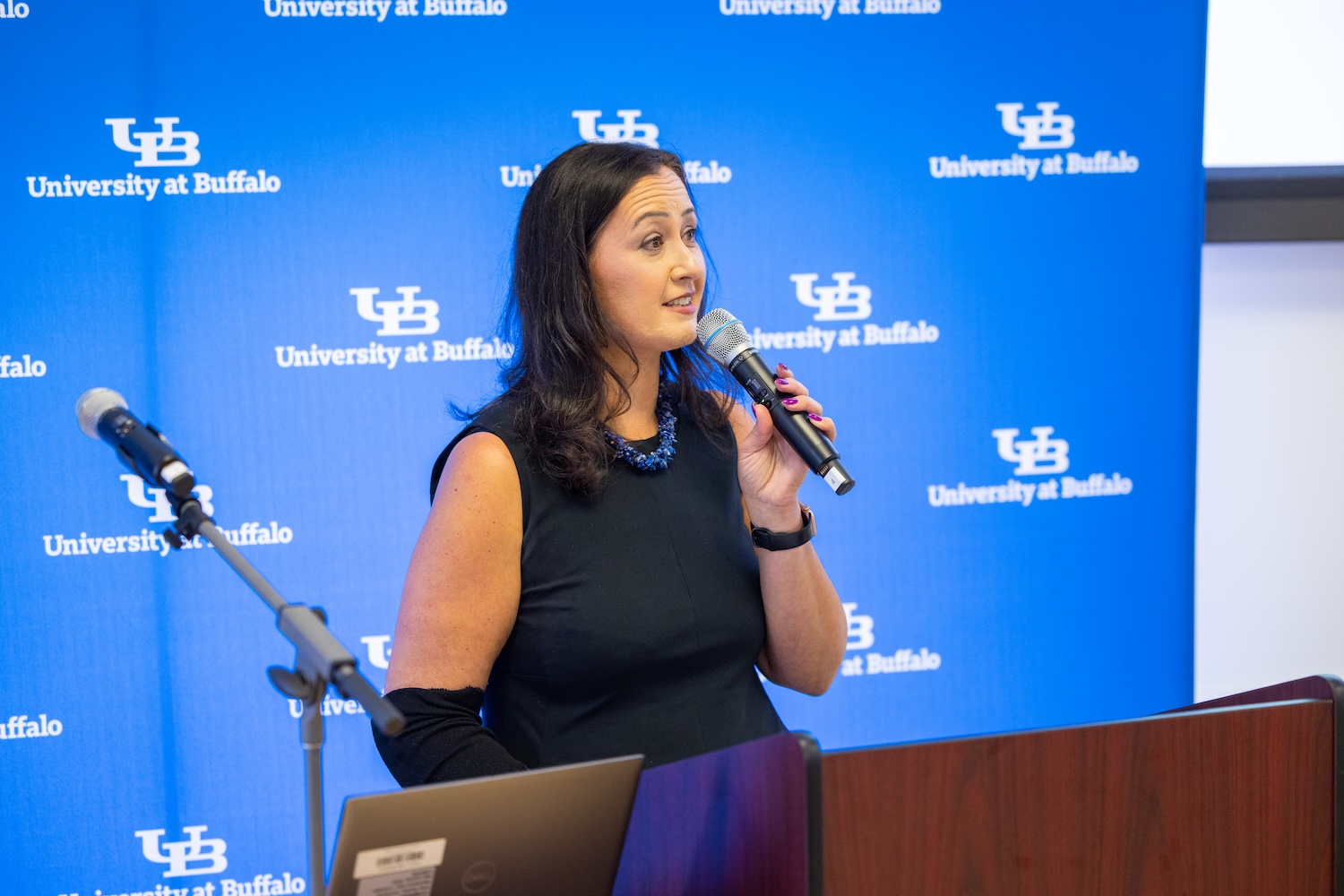
Hadar Borden has always seen her role as creating a culture of student entrepreneurship supported by Buffalo's startup community.
“As we look ahead, we invite you to become part of what’s next.”
Wearing a shiny blue Queen City track jacket, those were the words spoken by Hadar Borden at this year’s Panasci competition.
The evening's program was typical of Borden, director of the University at Buffalo's Startup and Innovation Collaboratory.
She announced a new advisory council to guide CoLab into a brighter future. She handed out “Luminary” awards to community members who’ve contributed to on-campus entrepreneurship. She stood with Dr. Brian Hamluk, UB’s vice president for student life, while he handed out prize checks to student entrepreneurs who’d pitched earlier in the night.
As students learned the outcome of the highly competitivePanasci competition, she was there celebrating alongside young adults she had been mentoring for months.
In other words, she brought a diverse and widespread community together to celebrate the culture of on-campus entrepreneurship that Borden had a big role in creating.
UB CoLab, which stewards entrepreneurship programming for students, turns 10 years old this year.
Borden spoke to Series B about what she’s accomplished, and the road ahead.
Talk to me about the early days of this movement.
The last 10 years have been about showing up on campus, showing up in the community and really changing the culture of student entrepreneurship at UB. It’s all about giving permission, inviting people in and showcasing how everyone has a place in innovation and entrepreneurship.
How have you worked to bring that mission into action?
We have tried to create experiences for the students that gave them touchpoints for entrepreneurship, and we focused on teaching everyone that it’s not like a secret that only certain people can do. Everyone has a place, even if you’re not the founder of a company.
With that in mind and with a lot of input throughout the community, we’ve opened this conversation up to innovation and intrapreneurship in different settings.
Think about it. As an R1 research university in the SUNY system, many of our students are first-generation college students who are being sent by their families to earn a degree and open the door to a job.
Fully embracing entrepreneurship is hard for some of them. But if you look at this beyond creating new startups, it’s a way of building an innovative culture where anyone can be involved.
You are very active drawing in members of Buffalo’s business community to support CoLab students and projects. Why is that?
One of the big things UB hears from industry partners is that they are looking to the university to feed that pipeline of new talent, and this is a way of creating a new kind of talent. When members of the business community engage with CoLab students, they find people who have been encouraged to think like innovators and bring a culture of entrepreneurship into their organizations..
Entrepreneurship teaches students how to creatively identify and solve problems.
How did you get involved in all of this?
I was the administrative director of UB’s Undergraduate Academies, and in 2010, I inherited the Prentice Foundation’s Prosperity Fellowship program, which was my entry into economic development.
A few years later, Tom Ulbrich (then running UB’s Center for Entrepreneurial Leadership, now president/CEO of Goodwill Western New York) pursued the Blackstone Charitable Foundation and led to the creation of a hands-on entrepreneurship program called Blackstone Launchpad at UB. I applied and was appointed its director in January 2016.
Why were you interested in the role?
I had experience with the Prosperity Fellowship and and I helped (local tech entrepreneur and civic leader) Eric Reich teach a class in the entrepreneurship academy for two years. I saw how he encouraged freshmen to think like an entrepreneur, and I started to feel a sense of connectivity between entrepreneurship and the university.
So I was excited by the idea of giving the university a place and a responsibility in the entrepreneurship community. Of course, we’ve always been involved, but I thought we could do more. This was a moment when 43North was really hitting its stride and there was a sense that things were really clicking in Buffalo’s startup community. People were excited and open to possibilities, and we wanted to connect our students to that.
What’s it like operating in both of those worlds – both UB and the external business community?
I think it was important to hire someone like me who understood the inner workings of the university, but had contacts with people who had strong reputations in the community, so we could bring both sides to the table and say, ‘How might we collaborate.’
CoLab now has a gallery of people – from entrepreneurs to business leaders, presidents and CEOs, our own alumni – who want to share their talent and their experience with our students. Our message to the students have been, ‘If you’re smart, you’ll use us to build your network.’
All of this has contributed to a culture where students come to us wanting to start businesses and solve problems, and not just for research or class projects, but something that can live beyond their university experience.
In 2016, we had about 30 teams apply to Panasci. This past year, we had 54 teams.
Ok, so what’s next?
Over the past 10 years, we’ve tried a lot of things and collected a lot of different experiences, and we noticed that we’re now telling a better story to our students to showcase what the journey through CoLab looks like.
It’s not just a series of standalone experiences. It’s helping them tell their story and pick up skills that are going to make them career-ready and competitive.
Panasci will continue to get bigger and better, along with many of our other programs. We’ll continue to go into classrooms and lead innovation sprints.
Something new that’s happening this fall is we’re creating a living-and-learning community in entrepreneurship, where 32 students will live together on Evans Hall, North Campus, and they’ll receive curated experiences around entrepreneurship and innovation in Buffalo.
This is a way of reaching student earlier in their journey and turning them into on-campus ambassadors for CoLab. The program already has a wait list and will be focused on giving students a creative, problem-solving mindset that extends beyond their academic work.
We’ve also learned that our students want more cohort-style experiences, and we’ve used that to create services for on-campus entrepreneurs. In spring 2025 we launched a CoLab marketing studio with 10 to 15 students who serve as an on-campus marketing agency for student entrepreneurs, and that worked so well that we’re launching a tech studio in the fall with the same concept. We’re also launching a product design studio.
Students will apply to these programs and they’ll run for a semester.
You’ve created many programs, supported thousands of students and carved out an important niche at UB and in Buffalo. What do you think all of that means?
First of all, it gives me so much joy when I’m in the community and I run into a former student who’s an entrepreneur or working at a startup or just using their skills to be more competitive in the workplace.
For the university, I think it makes us more relevant. The university has always contained innovation and entrepreneurship in pockets, but CoLab’s mission has been to change the culture so everyone embraces the entrepreneurial spirit. It goes back to asking, ‘What does entrepreneurship look like?’ And the answer is everyone.