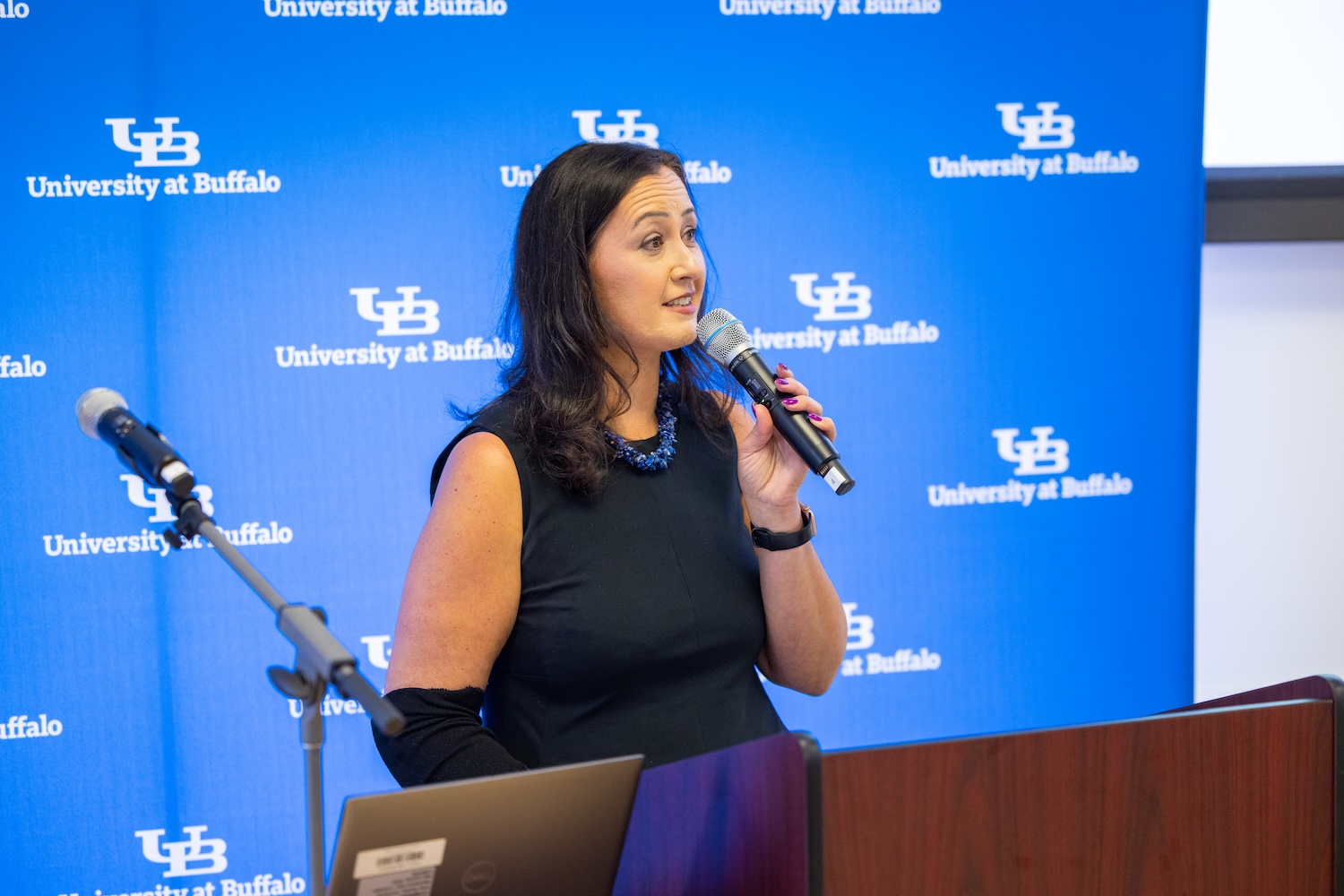
Starnes was hired as senior VP and CIO of Kaleida Health in 2023.
She’s leading a combined team of about 300 Kaleida employees through massive paradigm shifts at the intersection of tech and healthcare.
About 2.5 years ago, Courtney Lewis Starnes moved with her family from Kansas City to Buffalo to take on a deeply influential local role as Kaleida Health’s technology chief.
The senior VP and chief information officer is now embarking on a project that will change the delivery of healthcare in Western New York.
Along with the University at Buffalo and ECMC, the Epic electronic medical record platform will bring patient information into one system, giving physicians critical information that will inform treatment.
Starnes is one of two females in top technology positions at the biggest companies in Buffalo. Check out Series B’s recent profile of M&T Bank CIO Linda Tai here.
Starnes spoke to Series B recently about moving to Buffalo and the task at hand.

You relocated to Buffalo for this role. What made you take that step, and how do you see the city today?
Coming here, I didn’t know exactly what to expect.
What I found is a city that feels a lot like home. There’s a grounded, Midwest sensibility. People are down to earth but they’re also deeply committed to the community.
That combination of grit plus heart is real. When people here decide something matters, they follow through. You can see that in the work happening across the region, including in healthcare.
This EPIC transformation is a good example. It’s something the system has been working toward for years, and now there’s a shared commitment to making it happen.
More broadly, I see a lot of momentum. There’s a real focus on innovation, talent and growth, and a belief that Buffalo can continue to build on that foundation.
Like any region, there are challenges. But what stands out to me is the willingness to take them on directly. That’s what ultimately creates progress.
Tell me about your role as Kaleida’s CIO and your high-level priorities.
I joined Kaleida at the end of 2023 after spending my career in Kansas City in healthcare technology, both on the vendor side and within health systems. Early on, I was doing large-scale implementations and working across many organizations, but I found myself wanting to be closer to the actual patient impact.
That’s what drew me to roles inside health systems, and ultimately to Kaleida. The opportunity here was compelling. There was a clear vision for transformation, and a chance to help define the path forward.
Today, my role spans a broad set of responsibilities. We oversee cybersecurity, infrastructure, digital applications, informatics, analytics, clinical engineering and training. It’s a lean but powerful team of about 300 people supporting more than 11,000 employees and thousands of providers across the region.
At a high level, our mission is simple. Kaleida exists to care for patients. Our role in technology is to enable caregivers to do that as effectively as possible.

You’re leading a major system-wide transformation with Epic. How are you approaching leadership and execution for a project of this scale?
It starts with the “why.”
When we announced the Epic initiative in late 2024, the first priority was helping people understand why this matters. Today, Kaleida operates across multiple systems, with patient data spread across 13 different electronic health records. That creates real challenges for providers and, ultimately, for patients.
This project is about putting the patient at the center. When it’s complete, a patient’s information will follow them across the entire care journey, whether they’re seen at Kaleida, ECMC or by a UB provider.
From there, execution comes down to structure and discipline. We’ve built a strong governance model with hundreds of people involved across dozens of workgroups. That allows us to move quickly while still incorporating the perspectives we need.
Equally important is change management. This is a massive shift for thousands of people, so we’ve focused heavily on communication, training and early exposure to the system. We’ve tried to make it approachable, even fun at times, while staying very clear about what’s coming.
We’re now in the final stretch. It’s a bit like preparing for a marathon. There’s excitement, there are nerves, and there’s a lot of respect for the work it took to get here.
What kind of impact will this transformation have on patients and providers across Western New York?
The impact is significant.
For patients, it means greater access and convenience. They’ll be able to schedule appointments, connect with providers virtually and manage their care through a unified digital experience. More importantly, their data will follow them. That continuity leads directly to better, safer care.
For providers and care teams, it’s about clarity and efficiency. Instead of navigating multiple disconnected systems, they’ll have a single, integrated view of the patient. That allows for better decision-making and reduces duplicative work.
We’re also consolidating a large number of systems into a more streamlined, integrated environment. That creates more consistent workflows and frees up time for what matters most.
There are also new capabilities coming with Epic, including tools that support clinical decision-making and collaboration across the broader Epic network. We’re approaching areas like AI thoughtfully, with strong governance and transparency, using it to support—not replace—clinical judgment.
At its core, this is about improving how care is delivered across the region.
Technology is still a male-dominated field. What has your experience been as a female leader, and what advice would you offer others?
It’s not something I think about every day.
There are moments where you notice it, but my experience has really been grounded in the work itself. I’ve always believed that effort, results and surrounding yourself with the right people matter most.
One thing that has stood out to me is how people talk about success. You’ll often hear men attribute it to hard work, while women sometimes point to luck or circumstance. In reality, it’s both. Hard work matters, and so do the opportunities and support systems around you.
I’ve been fortunate to have strong mentors and sponsors throughout my career, both men and women. That’s made a real difference.
For others, my advice is to lean into your own style. Don’t try to fit a mold. Figure out what makes you effective and authentic, and build from there.
For me, that’s a combination of grit and heart. That balance has shaped how I lead, and it’s something I’ve found resonates strongly here in Buffalo.