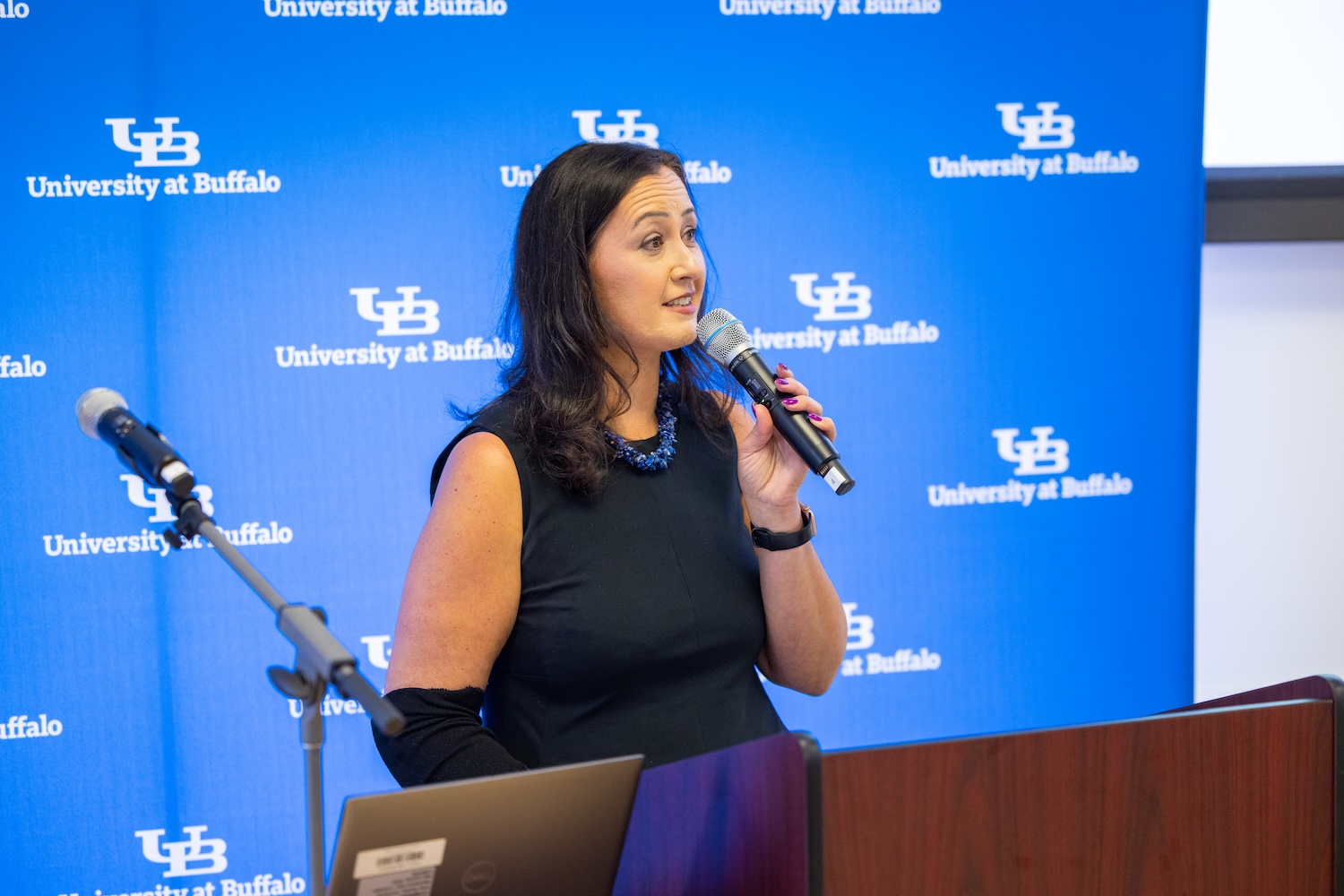
Linda Tai's distinguished career has carried her through Bank of America, Goldman Sachs and Fannie Mae.
Now she's leading the technology transformation at M&T Bank, the city's biggest public company and one of the largest banks in the U.S.
Linda Tai was appointed Chief Information Officer at M&T Bank in October 2024, overseeing everything from consumer and business banking technology to financial crimes to enterprise architecture.
Tai came to M&T after 25 years of high-level technology leadership roles, including Fannie Mae, where she served as senior VP and CTO, along with roles at Bank of America and Goldman Sachs.
Tai is the keynote speaker at this year’s Women in Tech WNY conference (registration and details here).
In the run-up to that event, she talked to Series B about her impressions of Buffalo, M&T’s role in the banking and technology landscape and succeeding as a female leader in tech.
M&T is an integral part of Buffalo’s economy and civic life. After a year and a half working here, what are your observations of the city - its strengths and its challenges?
Buffalo has a way of welcoming you in. You don’t adjust to Buffalo, Buffalo adopts you. There’s a strong sense of identity and pride here, and it shows up in both the community and the workplace. When you know where to find the best chicken wings and hear “Go Bills” at the end of a team meeting, you know you’re part of the system.
Beyond that, the city has a calm confidence. The lake is beautiful and serene, the food scene is exceptional, and people are genuinely kind and helpful. There’s a practical, no-nonsense mindset, paired with a deep commitment to doing things the right way rather than the fast way.
Like many regions, Buffalo faces challenges around attracting and retaining technical talent. But that also creates opportunity. Institutions like M&T can play an important role in showing that sophisticated, high-impact technology work can happen in non-traditional or emerging tech hubs like Buffalo. Supporting local talent and investing in capability is part of how the bank contributes to the city’s long-term strength.

You were a senior technology executive at some of the biggest names in banking and finance before joining M&T. What attracted you to this role?
What attracted me to M&T was the combination of readiness, purpose, and impact.
Over the past several years, the bank has made deliberate investments in its technology foundations - modernizing core platforms, strengthening resilience, and improving how teams deliver. That work matters because it enables the next phase of progress to compound, accelerate, and endure.
M&T is also distinctive in its mission. It is deeply community-driven, disciplined in how it operates, and consistently strong in its financial performance. That balance - purpose with results - is something I genuinely admire.
The role itself is impactful. Technology plays a central role in how the bank serves customers, manages risk, and grows responsibly. The opportunity to help shape that direction, while preserving the trust the bank has built over time, is what made the role compelling.
How do you view M&T’s role in the broader banking landscape in the years ahead? And as technology evolves rapidly, what is the bank’s strategy for staying ahead of the curve?
M&T’s role in the banking landscape is to demonstrate that strong risk management and customer trust are strategic advantages, not constraints. In an environment of rapid change, the institutions that endure are the ones that protect their customers, manage risk well, and make decisions with a long-term view.
The bank has always placed a high value on the well-being of its clients and communities, and that continues to guide how we think about technology. The goal isn’t innovation for its own sake - it’s using technology to improve reliability, security, and the quality-of-service customers experience every day.
Staying ahead of the curve requires being deliberate. We’re thoughtful about where we invest, how we sequence change, and how new capabilities integrate with the core of the bank. We focus on practical technological advancements that deliver clear business value rather than chasing what’s flashy. Over time, that consistency becomes a competitive advantage.
Technology is famously a male-dominated industry. What challenges did you face becoming a female leader in tech?
I’ve always approached my career with a focus on the work itself. In technology, credibility is built through consistent delivery, clear thinking, and results over time - not labels.
Early on, I learned to stay grounded in that principle. When expectations are clear and standards are high, performance speaks for itself. That reinforced my belief in meritocracy and in creating environments where people are evaluated by their contribution and outcomes.
As a leader today, my focus is on building teams where trust is earned through execution and accountability. When you do that well, differences in background become a strength rather than something that defines opportunity.
How did you overcome those challenges?
I focused on how the work was done, not on managing perception. That meant setting clear standards, making decisions grounded in data and risk awareness, and staying disciplined about execution.
Over time, consistent delivery builds trust. When platforms are stable, teams are aligned, and outcomes improve, credibility follows naturally. That approach scales far better than relying on individual effort alone.
As a leader, I’ve also been intentional about building strong teams and systems - creating environments where accountability is clear, people can do their best work, and results matter. When you do that well, progress becomes repeatable.
What advice do you have for women who want to break into - and ultimately lead -in technology?
My advice is to focus first on substance. Technology is a field where credibility comes from technical depth - understanding how systems work, why decisions matter, and how trade-offs affect outcomes. Strong fundamentals build confidence, and that confidence compounds over time.
It’s also important to keep learning. Technology doesn’t stand still, and neither can you. Continuous learning - whether deepening technical expertise or expanding understanding of the business and risk environment - is essential as complexity grows.
Finally, leadership follows impact. You don’t need a title to lead. When you consistently deliver, take ownership of hard problems, and raise the bar for yourself and others, influence comes naturally.