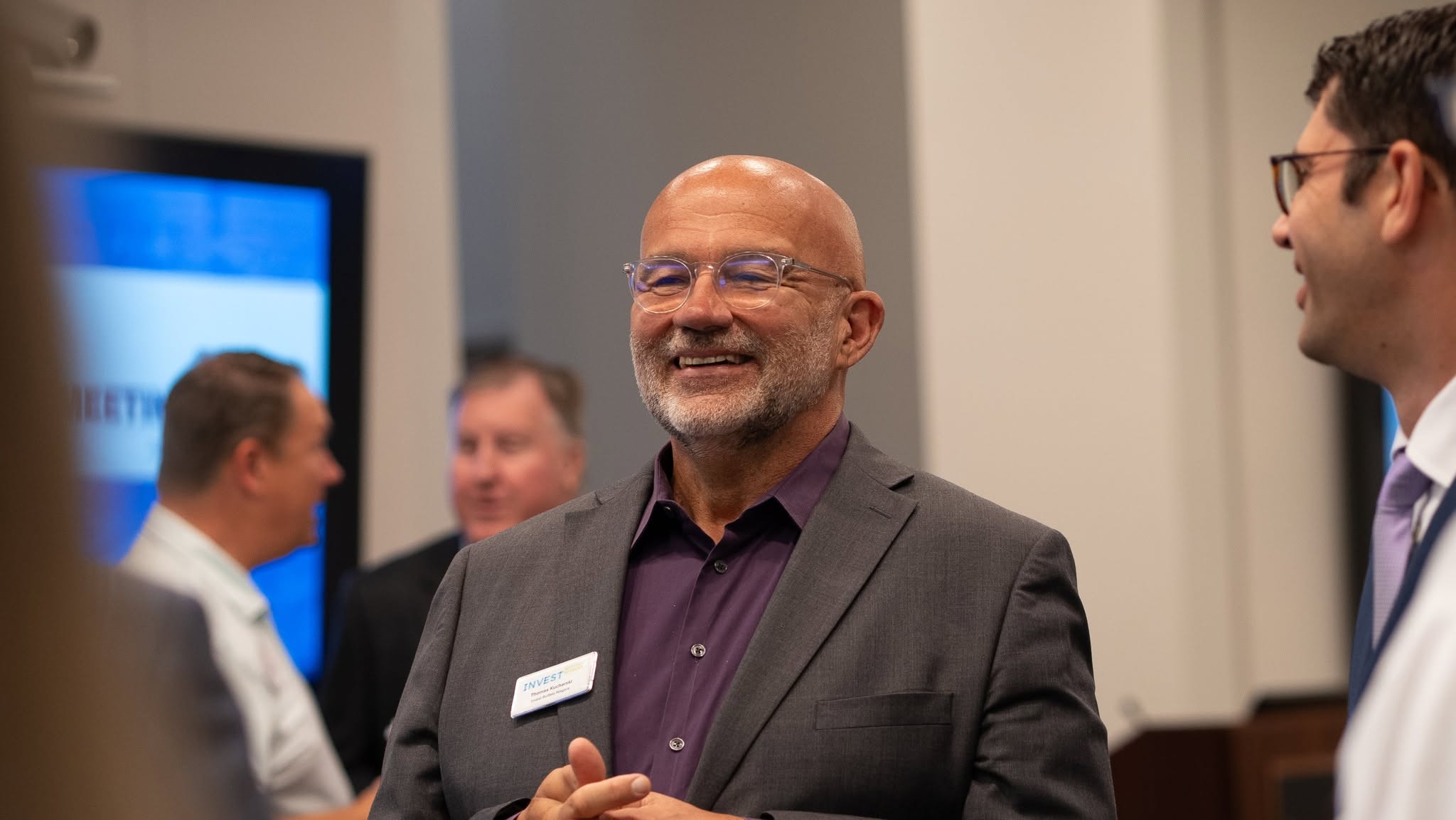
Departing Invest Buffalo Niagar CEO Tom Kucharski: "I cannot believe how much this region has changed in that time. And I cannot believe how much of Buffalo’s future still depends on whether we are finally willing to see ourselves clearly."
A guest column by Tom Kucharski, who officially retired Tuiesday after more than two decades as CEO of Invest Buffalo Niagara.
I cannot believe I am writing this.
I cannot believe that after helping build Invest Buffalo Niagara and leading it for 25 years, I am preparing to step away. I cannot believe how much this region has changed in that time. And I cannot believe how much of Buffalo’s future still depends on whether we are finally willing to see ourselves clearly.
This is not a retirement column. It is not a victory lap. It is not a list of the things I am proud to have been part of, though there are many.
It is a last call.
Because if there is one thing I want Buffalo to hear at this moment, it is this: our biggest challenge is no longer whether we have the assets to compete. It is whether we are finally willing to think and act like a region that already can.
For a long time, Buffalo’s humility has been part of its charm. It has made us grounded, resilient, and hard to shake. It has helped us endure periods when others wrote us off.
But what helps a place endure is not always what helps it lead.
At some point, humility can become hesitation. Modesty can become a ceiling. A city can become so used to being underestimated that it begins doing the work for everyone else.
That is the risk for Buffalo now.
The truth is, this is not a small or marginal region trying to manufacture relevance. The Buffalo-Cheektowaga-Niagara Falls metro had an estimated 1.156 million residents in 2025 and generated about $90.7 billion in GDP in 2023. Our regional price level also remains below the national average. Empire State Development points to another enduring advantage: Western New York produces more than 28,000 graduates annually from the region’s 20 colleges and universities. These are not the indicators of a place on the outside looking in. They are the indicators of a place with real scale, real talent, and real competitive strength.
And when you compare Buffalo with other midsize regions, the story holds up. Buffalo’s 2023 GDP was larger than Rochester’s and Grand Rapids-Wyoming’s, and not far behind Louisville’s. We are not talking about a city trying to talk itself into the conversation. We are talking about a region that belongs in it.
So let’s be honest about the problem.
Buffalo is not short on institutions. It is not short on work ethic. It is not short on talent, higher education, strategic location, or people who care deeply about its future.
What Buffalo is short on, too often, is alignment between its assets and its attitude.
We still talk about ourselves like a place waiting for permission. We still let old disappointments govern current ambition. We still tell the underdog story as if it is the only story available to us.
That has to change.
The underdog spirit may have carried Buffalo through certain eras. It may have helped us survive when survival was the task. But survival is not the same as excellence. And the instinct to expect less of ourselves, or to soften our own strengths before someone else challenges them, is not a strategy for the future.
This is not a call for arrogance. It is a call for standards.
We need to stop confusing likability with leadership. It needs to stop mistaking caution for wisdom. It needs to stop performing modesty when what this moment requires is confidence, urgency, and a commitment to excellence.
That means expecting more coordination. More follow-through. More ambition. More clarity about who we are and what we offer.
It means being willing to say that Buffalo should not just participate in the next economy. Buffalo should compete to lead in it.
If that sounds too abstract, look at what this city just watched unfold with the Sabres.
On Dec. 8, 2025, the Sabres were 11-14-4 and last in the Eastern Conference. Not long after, they became the first team in franchise history with multiple winning streaks of eight-plus games in one season. They returned to the playoffs for the first time since 2011, and on April 20 of this year they recorded their first postseason win since 2011. That turnaround felt improbable until it became undeniable.
That is not a perfect analogy for civic life, but it is a useful one.
Buffalo knows what it feels like to brace for disappointment. We also know what it feels like when belief comes rushing back. When a team, an institution, or a city stops carrying itself like it is waiting for the other shoe to drop and starts moving like it belongs in the fight.
That is the shift I believe Buffalo needs.
For years, I have had the privilege of helping tell this region’s story to business leaders, investors, employers, and decision-makers. I have seen what surprises them about Buffalo. I have seen how quickly assumptions fall away when people encounter the reality of this place.
But I have also seen something more stubborn.
Sometimes the hardest sell is not to outsiders. It is to ourselves.
That should concern all of us. Because the next chapter of Buffalo’s growth will not be built on announcements alone. It will not be built on sentiment. It will not be built on recycling old stories and hoping they still carry the same force.
It will be built on whether we are willing to match our mindset to our fundamentals.
We have the scale to matter. We have the affordability to compete. We have the talent base to build. What we need now is the discipline to stop introducing ourselves as potential and start introducing ourselves as performance.
So here is my final message, offered as plainly as I can:
Stop performing the underdog.
Stop waiting for someone else to tell you what Buffalo is capable of.
Stop letting humility do the work that confidence should be doing.
Choose excellence. Choose urgency. Choose conviction. Choose a bigger standard for this region than merely being resilient, likable, or underestimated.
See also:
Incoming BNP leader Grant Loomis on moving the economic needle in Buffalo
Tech Advisory Council will convene Buffalo's leading tech execs