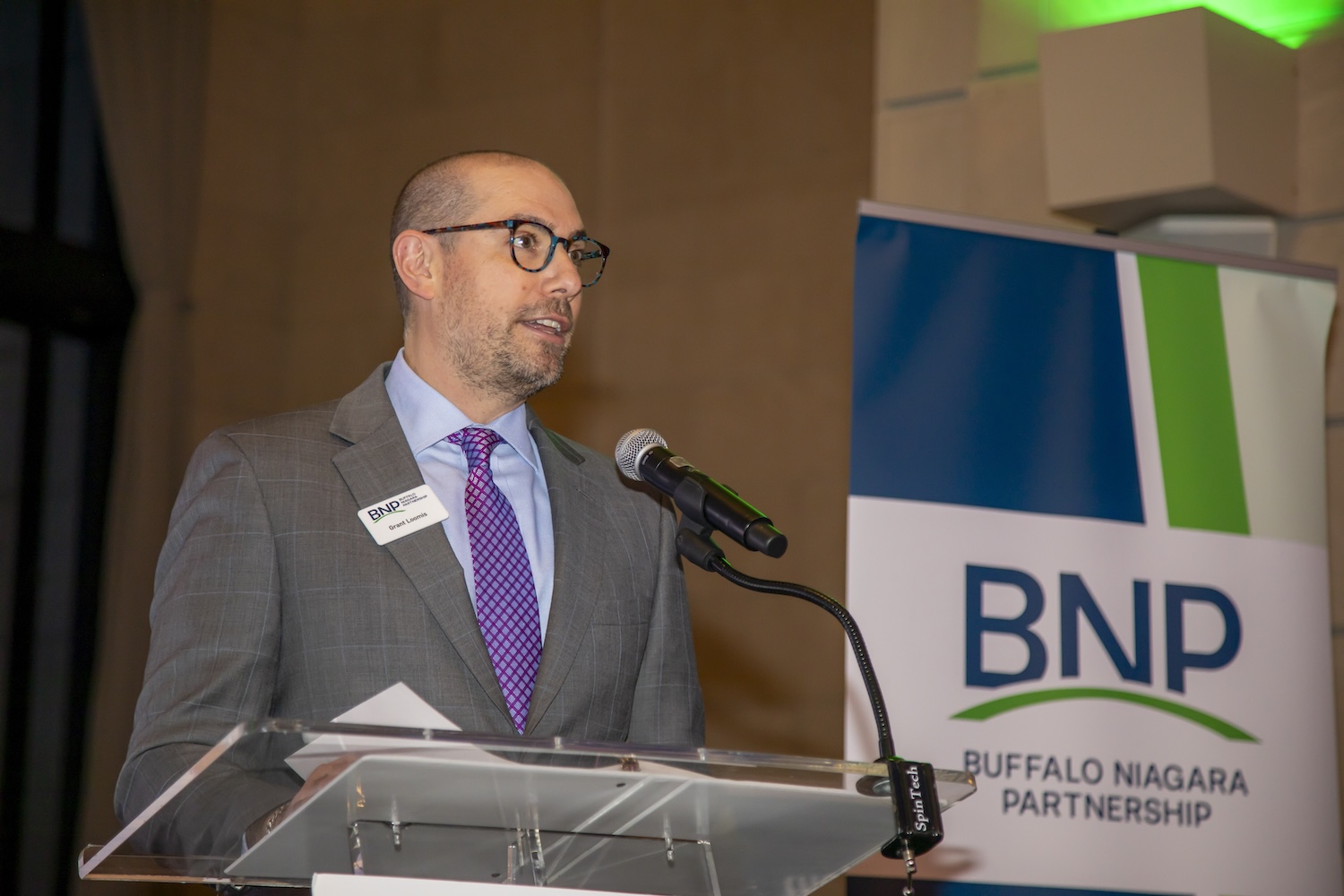
Loomis wants the Buffalo Niagara Partnership to play an even bigger role shaping the discussion around major decisions facing the future of the Buffalo region economy.
He’ll become CEO in June when longtime BNP leader Dottie Gallagher retires.
Grant Loomis is proud of the work that’s been done at the Buffalo Niagara Partnership, from its membership growth to advocacy wins on behalf of the local economy.
But as Loomis prepares to take over the CEO role from longtime leader Dottie Gallagher, who is retiring in June, he is bringing forward a strong vision for both the organization and the community.
That includes strengthening the organization’s voice and influence in important conversations.
“I definitely would like the Partnership to play more of a role in shaping the discussion around major decisions that will impact this community’s economic future,” Loomis said in a recent interview with Series B.
Loomis joined the BNP — the area’s regional chamber of commerce and a private economic development agency — more than 10 years ago. He was recently appointed president and COO, working closely with Gallagher and the BNP board to prepare for the new role.
Another important point for Loomis is changing the local economic benchmark. He wants Buffalo to move on from measuring itself by incremental success, which creates false signals about its actual performance relative to promise.
“We’ve gotten too comfortable saying we are better at X, Y and Z than we used to be five to ten years ago, and I’m not short-changing that, but we have to be willing to recognize where we’re still behind the 8-Ball relative to our peer metros,” Loomis said. “The Partnership should have a role in that truth-telling because we need to understand we’re not in competition against ourselves. We need to face the hard truths, come together and figure out policies or plans of attack that will move the needle.”
Series B had a wide-ranging conversation with Loomis about his new role, growth at the BNP and the needs of Buffalo businesses.
There’s a mix of optimism and concern.
Many employers are still trying to figure out what the post-pandemic economy is going to look like. Costs have gone up significantly. Inflation is affecting everyone. Some businesses are still struggling to secure financing, and tariffs — along with the uncertainty around them — have created challenges for a number of companies.
When businesses don’t feel confident about what’s ahead, investment tends to sit on the sidelines.
Talent is still another major challenge. Across sectors, employers are trying to figure out how to recruit and retain people at every level of their organizations.
At the same time, there are some encouraging signals.
There’s real excitement about new leadership in City Hall. After 20 years with the same mayor, employers are eager to build relationships with Mayor Ryan and his team.
There’s also cautious optimism about efforts in Albany to reduce unnecessary regulations and make permitting less burdensome.
And maybe most importantly, there’s a growing sense that this community wants to work together more intentionally than it has in the past.
We’ve definitely lost a little momentum over the past couple of years. You can feel it in the way people talk about the economy compared to where we were in 2019.
So the challenge now is how we get that momentum back.
At the end of the day, this community has to grow. We need to attract more people to the region but we also need to grow our own workforce.
Buffalo is still one of the poorest cities in the United States, and that should concern everyone in Western New York.
Until we make meaningful progress there, our growth will always have limits. Too many people are still sitting on the sidelines of economic mobility because of barriers like skills gaps, transportation, housing, or food insecurity.
If we want a stronger economy, we have to address those realities.
One of the biggest is the NY SMART-I Corridor, the federal Tech Hub connecting Buffalo, Rochester, and Syracuse.
The federal government has identified this region as a future center for semiconductor manufacturing. Eventually, one in four chips made in the United States could come from this part of the country.
That’s a massive opportunity. It reinforces the idea that we can build a strong innovation economy here — one that attracts entrepreneurs, investment, and talent from around the world.
But what might be even more important is how it came together.
For a long time, Buffalo, Rochester, and Syracuse saw each other as competitors. What this effort shows is that we’re actually stronger together than we are apart.
If we keep leaning into that collaboration across Upstate New York, we’ll be in a much stronger position to compete with other regions across the country.
I’m not coming in looking to reinvent the organization. In many ways, the Buffalo Niagara Partnership is more relevant today than it’s ever been, and our members rely on us in ways they probably never have before.
My job is to make sure we stay that way and become even more relevant.
That means growing the organization so we can provide more resources to regional employers as the region grows. It means bringing new members into the fold, deepening engagement with the members we already have, and continuing to strengthen the organization itself.
We have a team of about 21 people today. Over time, I’d like to create even more capacity so we can lean further into the work we’re doing and expand into areas where our members need us.
Advocacy is central to who we are. It’s part of the Partnership’s DNA, and I think we represent Western New York employers very well in that space.
But I also think we can do more — especially when it comes to local and regional advocacy.
A lot of the decisions that affect economic development happen at the city, county, and municipal levels. Those decisions shape the environment our employers operate in, and I think there’s room for us to play a bigger role there.