The Zeal Capital Partners founder is challenging how venture capital finds and funds entrepreneurs. He sees an opportunity in Buffalo.
Nasir Qadree has a theory about the future of venture capital: Some of the best investment opportunities are hiding in plain sight, far from the industry's traditional power centers.
He's putting that theory into practice.
Qadree is the founder and managing partner of Zeal Capital Partners, a Washington, D.C.-based venture capital firm managing approximately $186 million across investments in financial technology, healthcare, education and workforce innovation.
The firm has raised two core funds, including an $82 million fund that closed last year, and manages a $50 million investment vehicle on behalf of Barclays. Its strategy emphasizes early-stage investments, underserved markets and founders who might otherwise be overlooked by traditional venture capital.
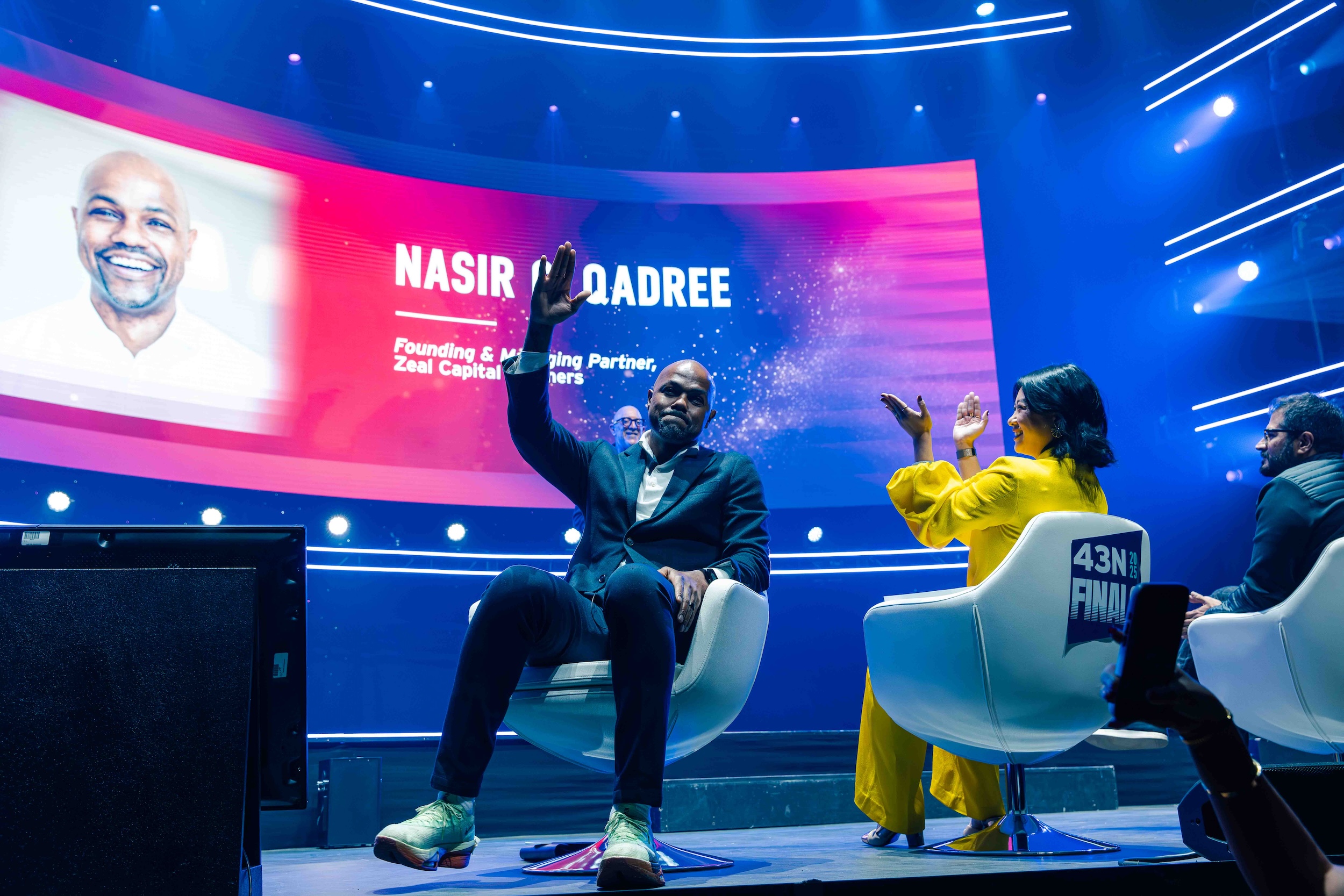
That approach has brought Qadree to Buffalo several times, including as a judge at last year's 43North Finals and, more recently, for a "Fly In With a VC" visit organized by 43North.
He sees similarities between Buffalo and cities such as Detroit and Pittsburgh, where industrial decline created the conditions for new generations of entrepreneurs to reshape their economies.
But Qadree is also concerned about the direction of venture capital itself. He believes too much money is flowing to too few firms, driving valuations to unsustainable levels and potentially leaving promising entrepreneurs behind.
Series B sat down with Qadree to discuss the changing venture capital landscape, what he looks for in founders and why he's developing a bullish thesis around Buffalo.
Let's start with Zeal Capital Partners. What are you building?
I founded the firm going on seven years ago with the goal of backing exceptional entrepreneurs building category-defining companies across financial services, healthcare, education and the future of work.
Our mission is to invest in innovation that's narrowing the health, wealth and skills gaps. And as AI has touched all three of those categories, our strategy has evolved.
We invest very early, from pre-seed through select Series A deals. We're willing to lead or co-lead investments, and we've built our strategy around a framework we call inclusive investing.
The idea is that if you're intentional about how you source, underwrite and support companies, you can build a portfolio of exceptional businesses that looks much more like the country itself.
That includes geographic inclusivity. We deliberately earmark travel dollars and investment dollars to get into communities where great entrepreneurs are building companies but may not have access to the same networks as founders in Silicon Valley or New York.
How has the firm evolved?
We're at an exciting inflection point, graduating from an emerging firm to a more established investment platform.
Our first fund was $54 million in 2021. We closed our second fund at $82 million last year, and we manage another $50 million on behalf of Barclays.
We've also built a venture scout program with 29 people across the United States, Canada and the United Kingdom.
These are people who have been on the front lines of supporting entrepreneurs in their own communities. They have proximity to founders and expertise in their markets, but many haven't had the opportunity to establish an investment track record.
We're giving them capital to invest and helping them develop the skills to become venture capital investors themselves.
That gives us boots on the ground in places like Denver, Des Moines, Detroit and Vancouver, as well as the traditional technology markets.
It's about getting in front of great companies early and making sure we at least have a chance to compete for those deals.
You've said venture capital is changing dramatically. What concerns you about the market right now?
When you look at the past few years, almost 80% of the capital has been allocated to a relatively small number of fund managers.
These are firms with tremendous brands and strong track records. They've earned that reputation. But the question is whether that concentration of capital is really allowing the industry to discover the full breadth of entrepreneurial talent across the country.
There's also a valuation issue.
Some of these firms have raised so much capital that they're investing enormous amounts in companies that, in many cases, don't have much revenue yet.
You see companies raising $20 million at a $100 million valuation. My concern is what happens when those entrepreneurs have to grow into those valuations.
You could see down rounds, recapitalizations and some very difficult situations for founders.
Does that create an opportunity for a firm like yours?
I think it does.
We're more conservative. We have smaller funds. We're not going to lead a $20 million seed round.
But we can help a company raise a $5 million to $7 million seed round at a $25 million to $30 million valuation.
The likelihood that the company can grow into that valuation is much higher.
Our job is to build a portfolio that reflects the actual opportunity in the market, rather than getting caught up in increasingly aggressive valuations.
And we believe there's a real advantage to finding exceptional entrepreneurs who aren't already surrounded by dozens of venture firms competing to write checks.
That brings us to Buffalo. What first attracted you to the city?
I've become fascinated by the resurgence of cities like Detroit, Pittsburgh and Buffalo.
Think about Detroit. At one point, the automobile was the hottest technology in the world. That's where people went for jobs, innovation and transformation.
Then you had the financial crisis, vacant buildings, boarded-up homes and businesses leaving.
But over time, you began to see a resurgence, supported by entrepreneurs, community organizations and local institutions that were committed to changing the trajectory.
I see some of those same ingredients in Buffalo.
You have local assets, economic development organizations and people who are rallying around entrepreneurs. Those organizations can play a critical role in helping change agents build companies and create economic opportunity.
I'm bullish on the idea that the best entrepreneurs exist everywhere, not just in a handful of cities.
And I think people like me have a responsibility to demonstrate what can happen when we intentionally direct our time and investment dollars into these communities.
You were a judge at 43North Finals last year. What stood out?
I've been to a lot of pitch competitions in New York, Silicon Valley, Atlanta and Nashville.
I don't think I've ever been to one that was more energetic or community-driven than what I experienced in Buffalo.
The difference was that the community genuinely felt part of the movement.
People weren't just showing up to watch entrepreneurs pitch. There was a sense that the city was invested in what those companies could become. For founders coming from outside Buffalo, that really matters.
You're asking someone to move their company, their employees and potentially their family to a new city. Seeing that level of support gives them confidence that they can build something meaningful there.
You've talked about a potential Buffalo thesis. What does that look like from an investor's perspective?
I think there's a real opportunity here, but you have to distinguish between theory and action.
The theory is that you have a city with a strong blue-collar spirit, a history of building things and a community that rallies around its entrepreneurs.
I find that really refreshing.
There's an authenticity here. People will tell you what they think. They'll talk about the real issues in their neighborhoods and communities. And they've lived through the ups and downs of an economy that's changed dramatically over time.
But then you have to ask: What are the problems we're actually trying to solve? And are those problems large enough to support venture-scale businesses?
Not every community challenge requires venture capital.
Maybe the answer is a public-private partnership or support for neighborhood businesses. Those are important, but they're different from building a technology company that can scale nationally.
The opportunity is to take that grassroots understanding of real problems and connect it with entrepreneurs who can build solutions that grow well beyond Buffalo.
What does it take for an entrepreneur in a place like Buffalo to get your attention?
I'm an in-person person. I want to understand who you are.
Are you the right founder to execute this strategy? Can I trust you?
When we wire the money, it's in your account. We're trusting you to do what you told us you were going to do.
Then we're looking at the team, the product, the market and the total addressable market.
Is this a painkiller or a vitamin? Is the company solving a problem that customers absolutely need solved, or is it something that's merely nice to have?
At the earliest stages, maybe you have a pilot or a pipeline of potential customers. By Series A, we want to see more evidence around revenue, margins and commercial partnerships.
We're also thinking about the financing strategy. Is the amount you're raising enough to get you to the next stage? Who else is going to invest alongside us? Who might finance the company after this round?
And ultimately, what does success look like?
Could this become a public company? Is there an acquisition opportunity? Does the founder actually want to build a venture-scale business?
Those are important conversations to have early.
How important is the local ecosystem in that decision?
Very important.
We're looking at the resources around a company. Are there customers, partners, talent and other investors who can help it grow?
That's part of what interests me about Buffalo.
You have organizations that are actively trying to connect those pieces. And you have a community that understands what it means to build something together.
But I also want entrepreneurs in these markets to understand how venture capital actually works.
It's still an opaque industry for a lot of people. Where does the money come from? How do firms make decisions? What do investors expect after they write a check?
Part of why I come to places like Buffalo is to help demystify that process.
I want founders to understand what a day in the life of a venture capitalist looks like, how we think about investments and what it really means to partner with a firm like ours.
You seem to have developed a personal connection to Buffalo, too. Where does that come from?
I actually came here as a kid.
My mother's husband, who I consider a bonus father, had family in Buffalo. A lot of them were firefighters and diehard Bills fans.
I remember going to the firehouses and seeing the Bills logos on their hats and the flags hanging up.
Years later, when I came back to Buffalo in a professional setting, I had this feeling of déjà vu.
And I still see that blue-collar spirit.
To me, blue collar means neighborhoods. It's not Hollywood. It's people who are grounded in their communities, who have experienced real challenges and who are willing to be honest about them.
That's something I appreciate.
So what's your outlook for Buffalo?
I'm bullish.
I believe some of the best entrepreneurs and change agents in this country are building companies outside the traditional technology hubs.
And I believe we're better off as a country when more of those people have access to capital and opportunity.
Buffalo has a community that's engaged, institutions that are rallying around entrepreneurship and people who genuinely want to see the city succeed.
The question now is how you translate that energy into businesses that can grow, create jobs and compete on a much larger stage.